News


Title
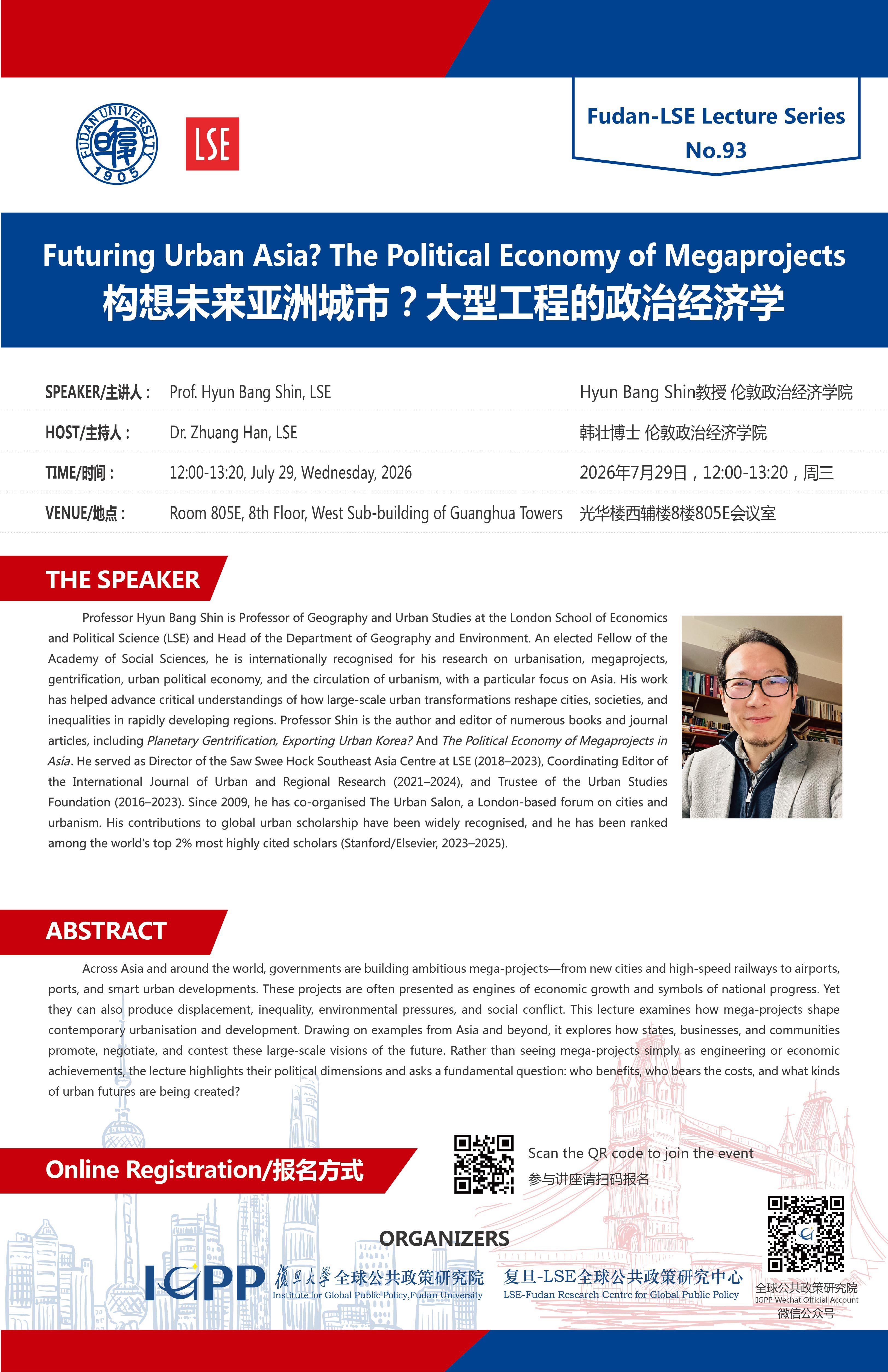
Futuring Urban Asia? The Political Economy of Megaprojects
Speaker
Prof. Hyun Bang Shin, LSE
Host
Dr. Zhuang Han, LSE
Time
12:00-13:20, July 29, Wednesday, 2026
Venue
Room 805E, 8th Floor, West Sub-building of Guanghua Towers
https://v.wjx.cn/vm/YDBv2c3.aspx#

The Speaker:

Prof. Hyun Bang Shin
Professor Hyun Bang Shin is Professor of Geography and Urban Studies at the London School of Economics and Political Science (LSE) and Head of the Department of Geography and Environment. An elected Fellow of the Academy of Social Sciences, he is internationally recognised for his research on urbanisation, megaprojects, gentrification, urban political economy, and the circulation of urbanism, with a particular focus on Asia. His work has helped advance critical understandings of how large-scale urban transformations reshape cities, societies, and inequalities in rapidly developing regions. Professor Shin is the author and editor of numerous books and journal articles, including Planetary Gentrification, Exporting Urban Korea? And The Political Economy of Megaprojects in Asia. He served as Director of the Saw Swee Hock Southeast Asia Centre at LSE (2018–2023), Coordinating Editor of the International Journal of Urban and Regional Research (2021–2024), and Trustee of the Urban Studies Foundation (2016–2023). Since 2009, he has co-organised The Urban Salon, a London-based forum on cities and urbanism. His contributions to global urban scholarship have been widely recognised, and he has been ranked among the world's top 2% most highly cited scholars (Stanford/Elsevier, 2023–2025).
Across Asia and around the world, governments are building ambitious mega-projects—from new cities and high-speed railways to airports, ports, and smart urban developments. These projects are often presented as engines of economic growth and symbols of national progress. Yet they can also produce displacement, inequality, environmental pressures, and social conflict. This lecture examines how mega-projects shape contemporary urbanisation and development. Drawing on examples from Asia and beyond, it explores how states, businesses, and communities promote, negotiate, and contest these large-scale visions of the future. Rather than seeing mega-projects simply as engineering or economic achievements, the lecture highlights their political dimensions and asks a fundamental question: who benefits, who bears the costs, and what kinds of urban futures are being created?