News


Title
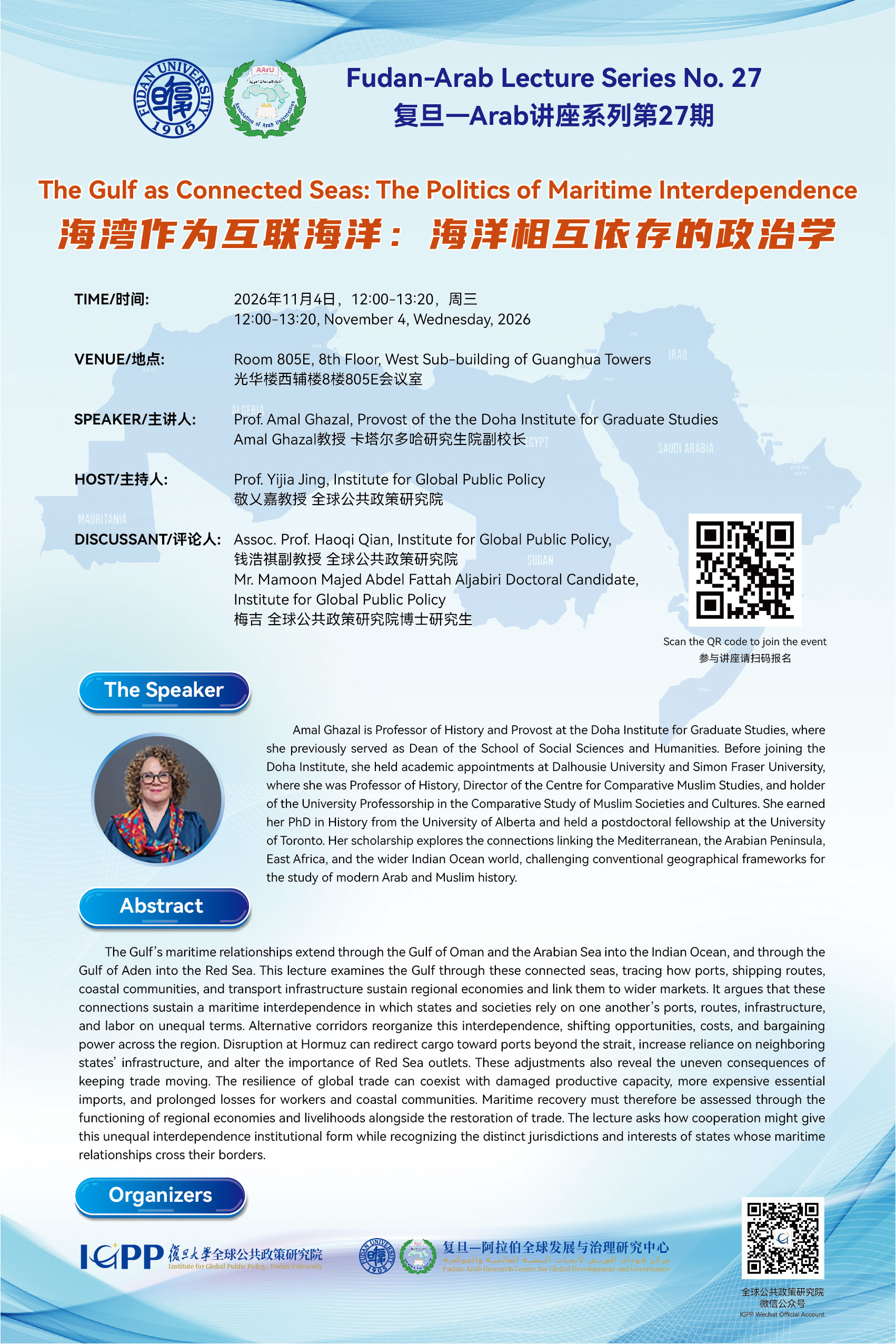
The Gulf as Connected Seas: The Politics of Maritime Interdependence
Speaker
Prof. Amal Ghazal, Provost of the the Doha Institute for Graduate Studies
Host
Prof. Yijia Jing, Institute for Global Public Policy
Discussant
Assoc. Prof. Haoqi Qian, Institute for Global Public Policy
Mr. Mamoon Majed Abdel Fattah Aljabiri Doctoral Candidate, Institute for Global Public Policy
Time
12:00-13:20, Nov 4, Wednesday, 2026
Venue
Room 805E, 8th Floor, West Sub-building of Guanghua Towers
https://v.wjx.cn/vm/ee9BXLc.aspx

The Speaker:

Prof. Amal Ghazal
Amal Ghazal is Professor of History and Provost at the Doha Institute for Graduate Studies, where she previously served as Dean of the School of Social Sciences and Humanities. Before joining the Doha Institute, she held academic appointments at Dalhousie University and Simon Fraser University, where she was Professor of History, Director of the Centre for Comparative Muslim Studies, and holder of the University Professorship in the Comparative Study of Muslim Societies and Cultures. She earned her PhD in History from the University of Alberta and held a postdoctoral fellowship at the University of Toronto. Her scholarship explores the connections linking the Mediterranean, the Arabian Peninsula, East Africa, and the wider Indian Ocean world, challenging conventional geographical frameworks for the study of modern Arab and Muslim history.
The Gulf’s maritime relationships extend through the Gulf of Oman and the Arabian Sea into the Indian Ocean, and through the Gulf of Aden into the Red Sea. This lecture examines the Gulf through these connected seas, tracing how ports, shipping routes, coastal communities, and transport infrastructure sustain regional economies and link them to wider markets. It argues that these connections sustain a maritime interdependence in which states and societies rely on one another’s ports, routes, infrastructure, and labor on unequal terms. Alternative corridors reorganize this interdependence, shifting opportunities, costs, and bargaining power across the region. Disruption at Hormuz can redirect cargo toward ports beyond the strait, increase reliance on neighboring states’ infrastructure, and alter the importance of Red Sea outlets. These adjustments also reveal the uneven consequences of keeping trade moving. The resilience of global trade can coexist with damaged productive capacity, more expensive essential imports, and prolonged losses for workers and coastal communities. Maritime recovery must therefore be assessed through the functioning of regional economies and livelihoods alongside the restoration of trade. The lecture asks how cooperation might give this unequal interdependence institutional form while recognizing the distinct jurisdictions and interests of states whose maritime relationships cross their borders.