News


Title
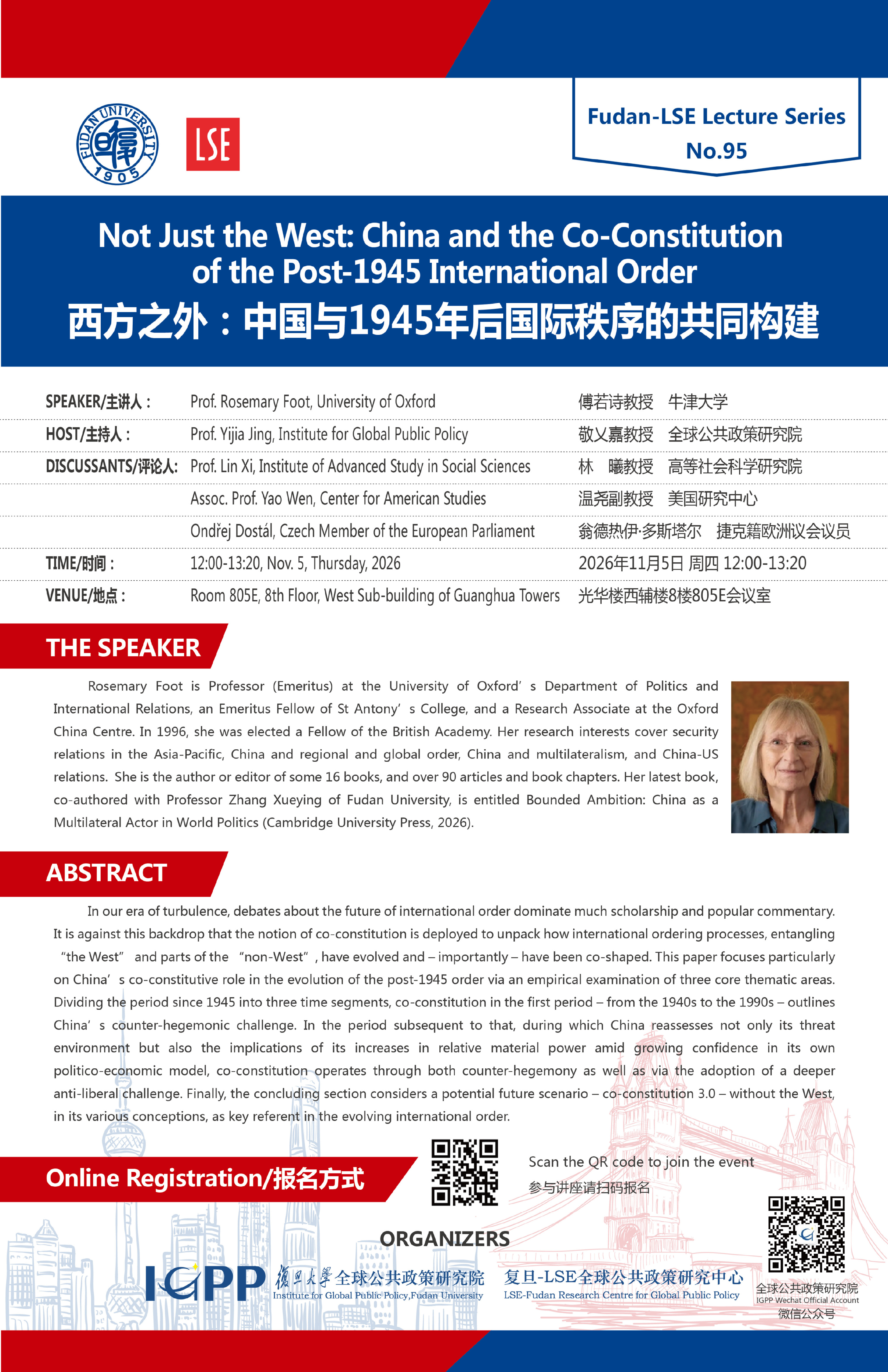
Not Just the West: China and the Co-Constitution of the Post-1945 International Order
Speaker
Prof. Rosemary Foot, University of Oxford
Host
Prof. Yijia Jing, Institute for Global Public Policy
Discussant
Prof. Lin Xi, Institute of Advanced Study in Social Sciences
Assoc. Prof. Yao Wen, Center for American Studies
Ondřej Dostál, Czech Member of the European Parliament
Time
12:00-13:20, Nov 5, Thursday, 2026
Venue
Room 805E, 8th Floor, West Sub-building of Guanghua Towers
https://v.wjx.cn/vm/tlbFGuH.aspx

The Speaker:

Prof. Rosemary Foot
Rosemary Foot is Professor (Emeritus) at the University of Oxford’s Department of Politics and International Relations, an Emeritus Fellow of St Antony’s College, and a Research Associate at the Oxford China Centre. In 1996, she was elected a Fellow of the British Academy. Her research interests cover security relations in the Asia-Pacific, China and regional and global order, China and multilateralism, and China-US relations. She is the author or editor of some 16 books, and over 90 articles and book chapters. Her latest book, co-authored with Professor Zhang Xueying of Fudan University, is entitled Bounded Ambition: China as a Multilateral Actor in World Politics (Cambridge University Press, 2026).
In our era of turbulence, debates about the future of international order dominate much scholarship and popular commentary. It is against this backdrop that the notion of co-constitution is deployed to unpack how international ordering processes, entangling “the West” and parts of the “non-West”, have evolved and – importantly – have been co-shaped. This paper focuses particularly on China’s co-constitutive role in the evolution of the post-1945 order via an empirical examination of three core thematic areas. Dividing the period since 1945 into three time segments, co-constitution in the first period – from the 1940s to the 1990s – outlines China’s counter-hegemonic challenge. In the period subsequent to that, during which China reassesses not only its threat environment but also the implications of its increases in relative material power amid growing confidence in its own politico-economic model, co-constitution operates through both counter-hegemony as well as via the adoption of a deeper anti-liberal challenge. Finally, the concluding section considers a potential future scenario – co-constitution 3.0 – without the West, in its various conceptions, as key referent in the evolving international order.