LSE-Fudan Centre


Title
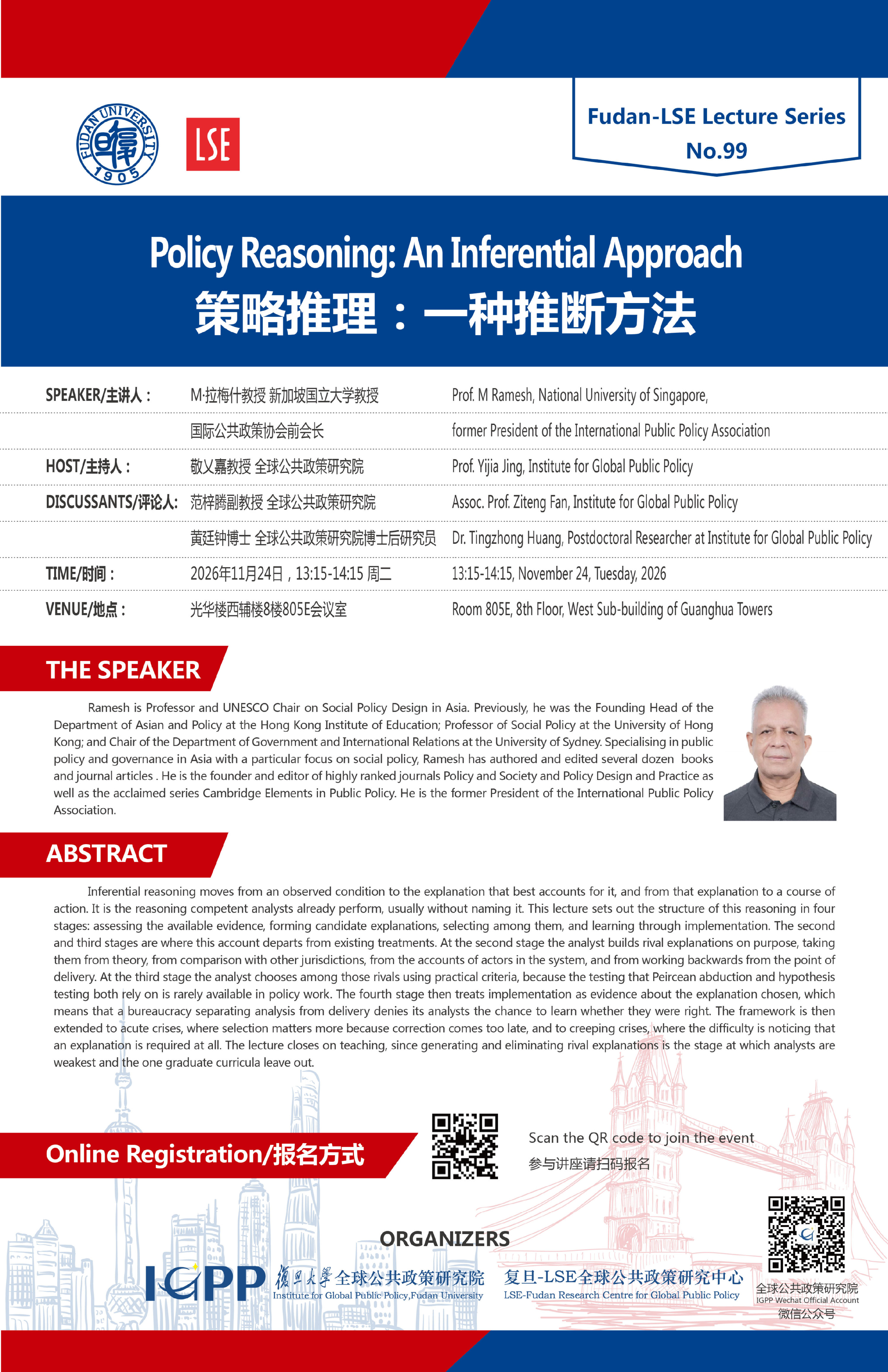
Policy Reasoning: An Inferential Approach
Speaker
Prof. M Ramesh, National University of Singapore, former President of the International Public Policy Association
Host
Prof. Yijia Jing, Institute for Global Public Policy
Discussant
Assoc. Prof. Ziteng Fan, Institute for Global Public Policy
Dr. Tingzhong Huang, Postdoctoral Researcher at Institute for Global Public Policy
Time
13:15-14:15, Nov 24, Tuesday, 2026
Venue
Room 805E, 8th Floor, West Sub-building of Guanghua Towers
https://v.wjx.cn/vm/t7QVW0E.aspx#

The Speaker:

Prof. M Ramesh
Ramesh is Professor and UNESCO Chair on Social Policy Design in Asia. Previously, he was the Founding Head of the Department of Asian and Policy at the Hong Kong Institute of Education; Professor of Social Policy at the University of Hong Kong; and Chair of the Department of Government and International Relations at the University of Sydney. Specialising in public policy and governance in Asia with a particular focus on social policy, Ramesh has authored and edited several dozen books and journal articles. He is the founder and editor of highly ranked journals Policy and Society and Policy Design and Practice as well as the acclaimed series Cambridge Elements in Public Policy. He is the former President of the International Public Policy Association.
Inferential reasoning moves from an observed condition to the explanation that best accounts for it, and from that explanation to a course of action. It is the reasoning competent analysts already perform, usually without naming it. This lecture sets out the structure of this reasoning in four stages: assessing the available evidence, forming candidate explanations, selecting among them, and learning through implementation. The second and third stages are where this account departs from existing treatments. At the second stage the analyst builds rival explanations on purpose, taking them from theory, from comparison with other jurisdictions, from the accounts of actors in the system, and from working backwards from the point of delivery. At the third stage the analyst chooses among those rivals using practical criteria, because the testing that Peircean abduction and hypothesis testing both rely on is rarely available in policy work. The fourth stage then treats implementation as evidence about the explanation chosen, which means that a bureaucracy separating analysis from delivery denies its analysts the chance to learn whether they were right. The framework is then extended to acute crises, where selection matters more because correction comes too late, and to creeping crises, where the difficulty is noticing that an explanation is required at all. The lecture closes on teaching, since generating and eliminating rival explanations is the stage at which analysts are weakest and the one graduate curricula leave out.