News


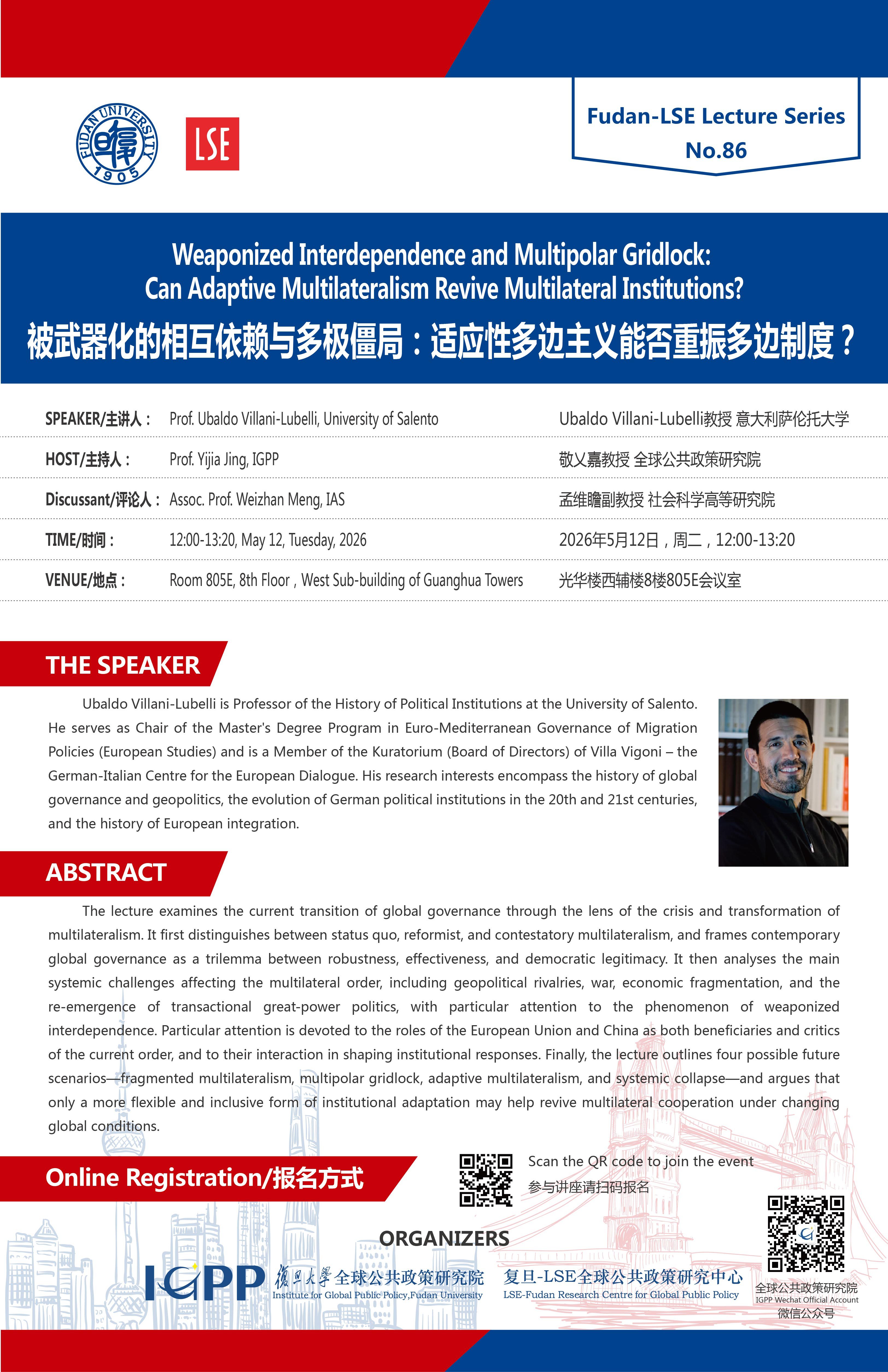
Fudan-LSE Lecture Series No.86
Title
Weaponized Interdependence and Multipolar Gridlock: Can Adaptive Multilateralism Revive Multilateral Institutions?
Speaker
Prof. Ubaldo Villani-Lubelli, University of Salento
Host
Prof. Yijia Jing, Fudan IGPP
Discussant
Assoc. Prof. Weizhan Meng, IAS
Time
12:00-13:20, May 12, Tuesday, 2026
Venue
Room 805E, 8th Floor, West Sub-building of Guanghua Towers
https://v.wjx.cn/vm/tRtB5dS.aspx#

The Speaker:
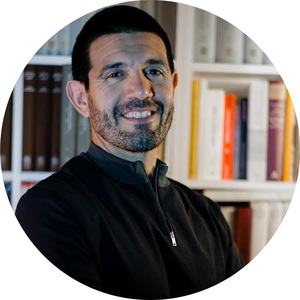
Prof. Ubaldo Villani-Lubelli
Ubaldo Villani-Lubelli is Professor of the History of Political Institutions at the University of Salento. He serves as Chair of the Master's Degree Program in Euro-Mediterranean Governance of Migration Policies (European Studies) and is a Member of the Kuratorium (Board of Directors) of Villa Vigoni – the German-Italian Centre for the European Dialogue. His research interests encompass the history of global governance and geopolitics, the evolution of German political institutions in the 20th and 21st centuries, and the history of European integration.
The lecture examines the current transition of global governance through the lens of the crisis and transformation of multilateralism. It first distinguishes between status quo, reformist, and contestatory multilateralism, and frames contemporary global governance as a trilemma between robustness, effectiveness, and democratic legitimacy. It then analyses the main systemic challenges affecting the multilateral order, including geopolitical rivalries, war, economic fragmentation, and the re-emergence of transactional great-power politics, with particular attention to the phenomenon of weaponized interdependence. Particular attention is devoted to the roles of the European Union and China as both beneficiaries and critics of the current order, and to their interaction in shaping institutional responses. Finally, the lecture outlines four possible future scenarios—fragmented multilateralism, multipolar gridlock, adaptive multilateralism, and systemic collapse—and argues that only a more flexible and inclusive form of institutional adaptation may help revive multilateral cooperation under changing global conditions.