News


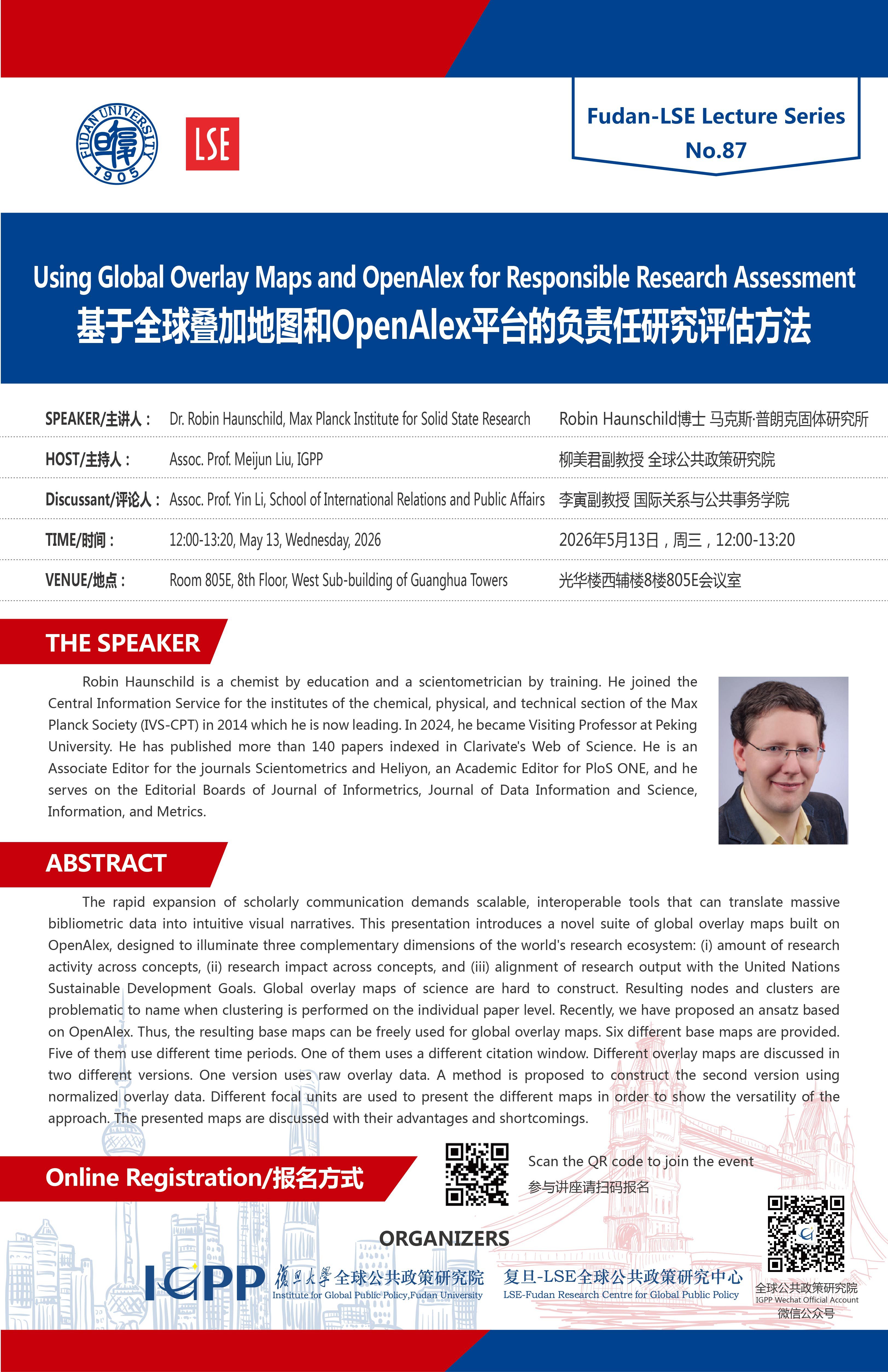
Fudan-LSE Lecture Series No.87
Title
Using Global Overlay Maps and OpenAlex for Responsible Research Assessment
Speaker
Dr. Robin Haunschild, Max Planck Institute for Solid State Research
Host
Assoc. Prof. Meijun Liu, IGPP
Discussant
Assoc. Prof. Yin Li, School of International Relations and Public Affairs
Time
12:00-13:20, May 13, Wednesday, 2026
Venue
Room 805E, 8th Floor, West Sub-building of Guanghua Towers
https://v.wjx.cn/vm/heaAvnL.aspx#

The Speaker:
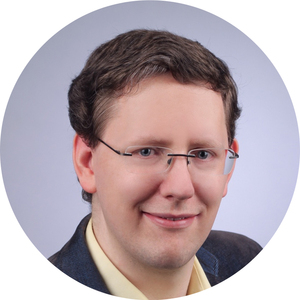
Dr. Robin Haunschild
Robin Haunschild is a chemist by education and a scientometrician by training. He joined the Central Information Service for the institutes of the chemical, physical, and technical section of the Max Planck Society (IVS-CPT) in 2014 which he is now leading. In 2024, he became Visiting Professor at Peking University. He has published more than 140 papers indexed in Clarivate’s Web of Science. He is an Associate Editor for the journals Scientometrics and Heliyon, an Academic Editor for PloS ONE, and he serves on the Editorial Boards of Journal of Informetrics, Journal of Data Information and Science, Information, and Metrics.
The rapid expansion of scholarly communication demands scalable, interoperable tools that can translate massive bibliometric data into intuitive visual narratives. This presentation introduces a novel suite of global overlay maps built on OpenAlex, designed to illuminate three complementary dimensions of the world’s research ecosystem: (i) amount of research activity across concepts, (ii) research impact across concepts, and (iii) alignment of research output with the United Nations Sustainable Development Goals. Global overlay maps of science are hard to construct. Resulting nodes and clusters are problematic to name when clustering is performed on the individual paper level. Recently, we have proposed an ansatz based on OpenAlex. Thus, the resulting base maps can be freely used for global overlay maps. Six different base maps are provided. Five of them use different time periods. One of them uses a different citation window. Different overlay maps are discussed in two different versions. One version uses raw overlay data. A method is proposed to construct the second version using normalized overlay data. Different focal units are used to present the different maps in order to show the versatility of the approach. The presented maps are discussed with their advantages and shortcomings.