News


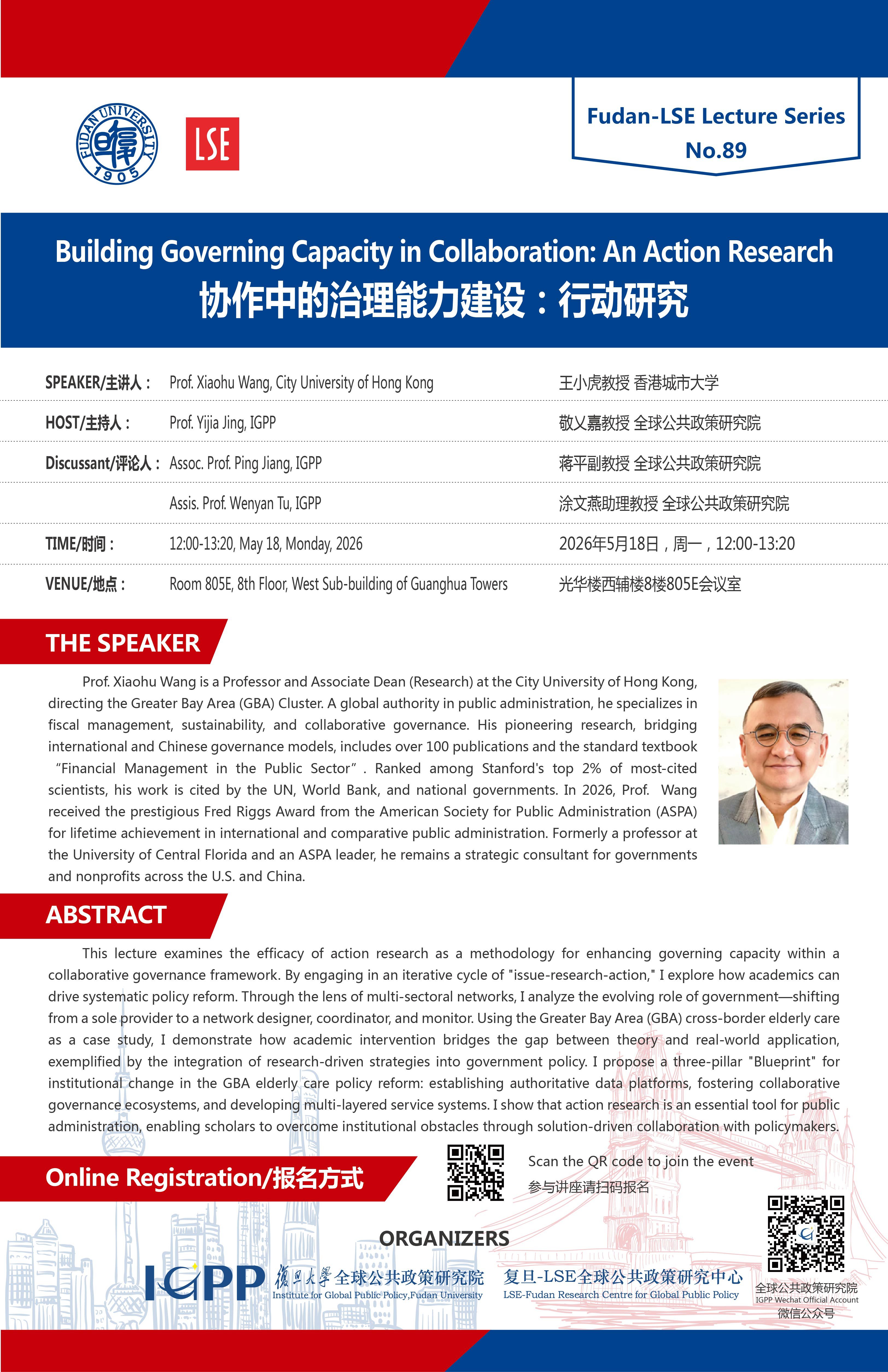
Fudan-LSE Lecture Series No.89
Title
Building Governing Capacity in Collaboration: An Action Research
Speaker
Prof. Xiaohu Wang, City University of Hong Kong
Host
Prof .Yijia Jing, IGPP
Discussant
Assoc. Prof. Ping Jiang, IGPP
Assis. Prof. Wenyan Tu, IGPP
Time
12:00-13:20, May 18, Monday, 2026
Venue
Room 805E, 8th Floor, West Sub-building of Guanghua Towers
https://v.wjx.cn/vm/PpfY5QJ.aspx#

The Speaker:

Prof. Xiaohu Wang
Prof. Xiaohu Wang is a Professor and Associate Dean (Research) at the City University of Hong Kong, directing the Greater Bay Area (GBA) Cluster. A global authority in public administration, he specializes in fiscal management, sustainability, and collaborative governance. His pioneering research, bridging international and Chinese governance models, includes over 100 publications and the standard textbook “Financial Management in the Public Sector”. Ranked among Stanford’s top 2% of most-cited scientists, his work is cited by the UN, World Bank, and national governments. In 2026, Prof. Wang received the prestigious Fred Riggs Award from the American Society for Public Administration (ASPA) for lifetime achievement in international and comparative public administration. Formerly a professor at the University of Central Florida and an ASPA leader, he remains a strategic consultant for governments and nonprofits across the U.S. and China.
This lecture examines the efficacy of action research as a methodology for enhancing governing capacity within a collaborative governance framework. By engaging in an iterative cycle of 'issue-research-action,' I explore how academics can drive systematic policy reform. Through the lens of multi-sectoral networks, I analyze the evolving role of government—shifting from a sole provider to a network designer, coordinator, and monitor. Using the Greater Bay Area (GBA) cross-border elderly care as a case study, I demonstrate how academic intervention bridges the gap between theory and real-world application, exemplified by the integration of research-driven strategies into government policy. I propose a three-pillar 'Blueprint' for institutional change in the GBA elderly care policy reform: establishing authoritative data platforms, fostering collaborative governance ecosystems, and developing multi-layered service systems. I show that action research is an essential tool for public administration, enabling scholars to overcome institutional obstacles through solution-driven collaboration with policymakers.