News


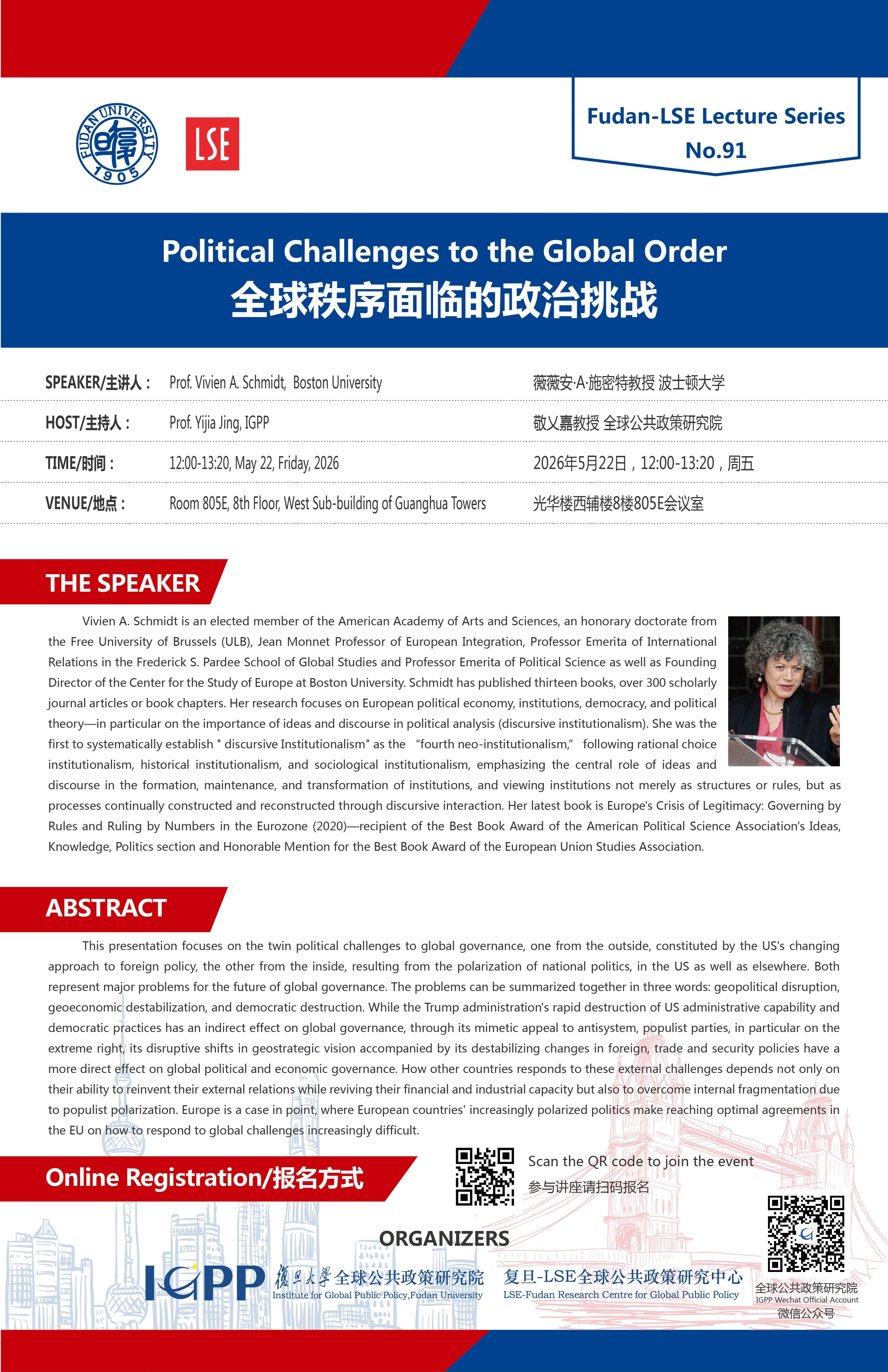
Fudan-LSE Lecture Series No.91
Title
Political Challenges to the Global Order
Speaker
Prof. Vivien A. Schmidt, Boston University
Host
Prof. Yijia Jing, IGPP
Time
12:00-13:20, May 22, Friday, 2026
Venue
Room 805E, 8th Floor, West Sub-building of Guanghua Towers
https://v.wjx.cn/vm/h4aLKrC.aspx#

The Speaker:

Prof. Vivien A. Schmidt
Vivien A. Schmidt is an elected member of the American Academy of Arts and Sciences, an honorary doctorate from the Free University of Brussels (ULB), Jean Monnet Professor of European Integration, Professor Emerita of International Relations in the Frederick S. Pardee School of Global Studies and Professor Emerita of Political Science as well as Founding Director of the Center for the Study of Europe at Boston University. Schmidt has published thirteen books, over 300 scholarly journal articles or book chapters. Her research focuses on European political economy, institutions, democracy, and political theory—in particular on the importance of ideas and discourse in political analysis (discursive institutionalism). She was the first to systematically establish ' discursive Institutionalism' as the “fourth neo-institutionalism,” following rational choice institutionalism, historical institutionalism, and sociological institutionalism, emphasizing the central role of ideas and discourse in the formation, maintenance, and transformation of institutions, and viewing institutions not merely as structures or rules, but as processes continually constructed and reconstructed through discursive interaction. Her latest book is Europe’s Crisis of Legitimacy: Governing by Rules and Ruling by Numbers in the Eurozone (2020)—recipient of the Best Book Award of the American Political Science Association’s Ideas, Knowledge, Politics section and Honorable Mention for the Best Book Award of the European Union Studies Association.
This presentation focuses on the twin political challenges to global governance, one from the outside, constituted by the US’s changing approach to foreign policy, the other from the inside, resulting from the polarization of national politics, in the US as well as elsewhere. Both represent major problems for the future of global governance. The problems can be summarized together in three words: geopolitical disruption, geoeconomic destabilization, and democratic destruction. While the Trump administration’s rapid destruction of US administrative capability and democratic practices has an indirect effect on global governance, through its mimetic appeal to antisystem, populist parties, in particular on the extreme right, its disruptive shifts in geostrategic vision accompanied by its destabilizing changes in foreign, trade and security policies have a more direct effect on global political and economic governance. How other countries responds to these external challenges depends not only on their ability to reinvent their external relations while reviving their financial and industrial capacity but also to overcome internal fragmentation due to populist polarization. Europe is a case in point, where European countries’ increasingly polarized politics make reaching optimal agreements in the EU on how to respond to global challenges increasingly difficult.