News


Title
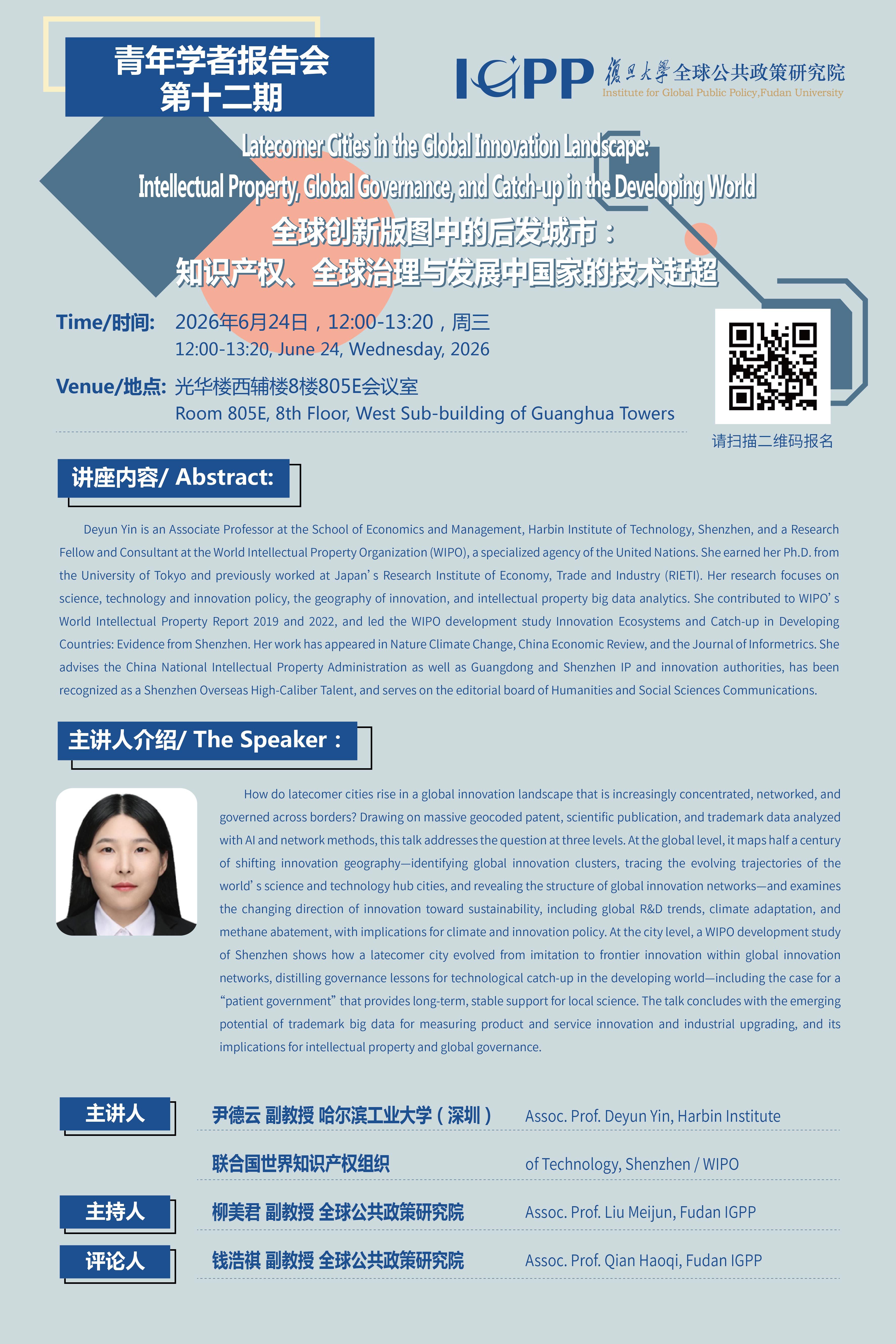
Latecomer Cities in the Global Innovation Landscape: Intellectual Property, Global Governance, and Catch-up in the Developing World
Speaker
Assoc. Prof. Deyun Yin, Harbin Institute of Technology, Shenzhen / WIPO
Host
Assoc. Prof. Liu Meijun, Fudan IGPP
Discussant
Assoc. Prof. Qian Haoqi, Fudan IGPP
Time
12:00-13:20, June 24, Wednesday, 2026
Venue
Room 805E, 8th Floor, West Sub-building of Guanghua Towers
https://v.wjx.cn/vm/PWxbcYt.aspx#

The Speaker:

Assoc. Prof. Deyun Yin
Deyun Yin is an Associate Professor at the School of Economics and Management, Harbin Institute of Technology, Shenzhen, and a Research Fellow and Consultant at the World Intellectual Property Organization (WIPO), a specialized agency of the United Nations. She earned her Ph.D. from the University of Tokyo and previously worked at Japan’s Research Institute of Economy, Trade and Industry (RIETI). Her research focuses on science, technology and innovation policy, the geography of innovation, and intellectual property big data analytics. She contributed to WIPO’s World Intellectual Property Report 2019 and 2022, and led the WIPO development study Innovation Ecosystems and Catch-up in Developing Countries: Evidence from Shenzhen. Her work has appeared in Nature Climate Change, China Economic Review, and the Journal of Informetrics. She advises the China National Intellectual Property Administration as well as Guangdong and Shenzhen IP and innovation authorities, has been recognized as a Shenzhen Overseas High-Caliber Talent, and serves on the editorial board of Humanities and Social Sciences Communications.
How do latecomer cities rise in a global innovation landscape that is increasingly concentrated, networked, and governed across borders? Drawing on massive geocoded patent, scientific publication, and trademark data analyzed with AI and network methods, this talk addresses the question at three levels. At the global level, it maps half a century of shifting innovation geography—identifying global innovation clusters, tracing the evolving trajectories of the world’s science and technology hub cities, and revealing the structure of global innovation networks—and examines the changing direction of innovation toward sustainability, including global R&D trends, climate adaptation, and methane abatement, with implications for climate and innovation policy. At the city level, a WIPO development study of Shenzhen shows how a latecomer city evolved from imitation to frontier innovation within global innovation networks, distilling governance lessons for technological catch-up in the developing world—including the case for a “patient government” that provides long-term, stable support for local science. The talk concludes with the emerging potential of trademark big data for measuring product and service innovation and industrial upgrading, and its implications for intellectual property and global governance.